How to Pick a Customer Feedback Tool: Prices and Fit by the Job You Have
"Customer feedback tool" isn't one category — it's two jobs. Some tools help you ask for feedback (surveys and CX measurement); others help you process the feedback already arriving (voting boards, AI triage). Tools like Triagely, Canny, Featurebase, Sleekplan, Productboard, Nolt and UserVoice split across that line. Decide which job you have before you compare prices, because the two halves barely overlap.
There's a third job hiding inside "processing" that the category names rarely spell out: sifting a flood of inbound feedback — grouping duplicate reports and deciding what to act on — separate from running a survey and separate from hosting a public voting board. That's the job a tool like Triagely is built for, and it's why the price you should pay depends entirely on which of these three problems is actually yours.
Here are the tools with published entry prices, the job each does, and who each is wrong for. Only tools with real, on-record pricing go in the table.
| Tool | The job it does | Entry price (monthly) | Wrong for |
|---|---|---|---|
| Canny | Public voting board | Free $0 (≤25 tracked users), Pro $79 billed yearly, Business custom; USD | Budget-tight SMBs as tracked users climb |
| Featurebase | Board + support suite | Free $0 (1 seat, no AI), Growth $29/seat, Pro $59/seat, +$0.29/AI resolution; USD | Teams that want one flat price, not per-seat |
| Triagely | AI triage of your own inbound | Starter €19/$22 (1 project), Pro €39/$45 (unlimited); EUR | Teams wanting a ready-made public voting board |
| Sleekplan | Board + changelog + surveys | Indie $0 forever (1 admin), Starter $13, Business $38; USD | Teams needing a heavyweight enterprise CXM program |
| Productboard | Product management | Free $0, Plus $19/maker, Business $59/maker; USD | Solo founders (priced per maker) |
| Nolt | A single voting board | Essential $29 yearly ($39 monthly), Pro $69 yearly; USD | Teams needing many boards cheaply (billed per board) |
| UserVoice | Enterprise feedback mgmt | No public pricing; quoted after a demo, usage-based not per-seat; USD | Small teams wanting self-serve signup |
What's the difference between a survey tool and a feedback management tool?
The buyer's real fork is this: are you trying to ask for feedback you don't have yet, or process feedback that's already flooding in? Your answer decides which half of the market you shop, and the two halves barely share a feature.
Within this one label a buyer actually faces five practical buckets:
- Survey and form tools — Typeform, SurveyMonkey, Qualaroo. You compose a question and send it out by link or on your site.
- AI triage and de-duplication — Triagely, Usersnap. You point them at the feedback already arriving: email, an in-app widget, your support tickets; and they merge duplicate reports into one, categorize each, and rank what to fix next. No new survey, no public board to run; just the inbound pile, sorted.
- Feedback management and voting boards — Canny, UserVoice, Featurebase, Sleekplan. Users submit and vote; you run a roadmap off the pile.
A survey tool and a triage tool solve opposite ends of the same pipe: one creates feedback, the other clears it. So the best tool only has an answer once you've picked which end you're standing at.
Why does collected feedback so often go nowhere?
Because collecting is the easy half, and most teams stop there. Fortune's reporting on feedback fatigue captures the grievance exactly: a frequent flyer describes handing over feedback again and again and getting "radio silence on the other side". The company asked; nothing visibly changed.
That silence is what drives survey fatigue. Qualtrics' Brad Anderson tells Fortune plainly that "survey fatigue is real", describing the same brand bombarding one person over and over. Practitioner guidance pins the cause on customers not seeing the point — asked constantly while companies rarely act on it in any tangible way.
The spend-versus-insight gap makes it starker. U.S. firms will have spent about $36.4 billion on market research in 2025, a bill rising nearly 4% a year — yet Wharton's Peter Fader concludes that despite the spending, surveys rarely produce "meaningful insights". Meanwhile the raw volume keeps climbing: Qualtrics says the interactions processed on its platform have doubled since 2023 to more than 3.5 billion a year.
So the bottleneck for many teams isn't collecting more feedback — it's processing what already arrives, which is why the "processing" half matters even when the flashiest tools all sit in the "asking" half.
Survey and CX tools: for when you need to ASK
This half is genuinely good at one thing: proactively asking a defined question — onboarding, post-purchase, NPS or CSAT — and measuring sentiment over time. If you don't yet have the feedback and you want to go get it on a schedule, this is your shelf.
The players sort by fit rather than by a price table (there's no reliable published pricing to quote for most of them):
- Typeform, SurveyMonkey, Qualaroo — self-serve survey and form builders for asking on your own site or by a shared link.
- Hotjar, Sprig — in-app and behavioral prompts that catch a reaction in context, while the user is still in the flow.
- Qualtrics, Medallia — enterprise CX programs at scale; Qualtrics itself is the one flagging survey fatigue as the category's built-in risk.
The caveat for the whole half: every survey you send adds to the fatigue above, and the responses you collect still have to be read, de-duped, and acted on. The tool that asks is not the tool that processes — that gap between collecting and acting is exactly the "radio silence" customers resent. A founder who already has more inbound feedback than they can read doesn't need another way to ask; they need a way to sift.
Worth knowing as a buyer: several of the "best feedback tool" round-ups are published by survey and CX vendors themselves, leading with their own product. Read category advice knowing who wrote it and what they sell.
Feedback management and voting boards: for when you need to PROCESS via a public board
This half is for the opposite situation: users submit ideas and bugs, others vote, and you run a public roadmap and changelog off the pile. Here real pricing exists, so here's the detail — currency flagged USD throughout, with one honest "wrong for" each.
Canny. The Free plan is $0 and caps tracked users at 25; Pro is $79/mo billed yearly starting at 100+ tracked users; Business is custom above 5,000, and a Pro trial is offered. The documented gripe, from a competitor's own teardown, is "expensive pricing and limited plans" for smaller companies, alongside a note that Canny is raising prices for a fourth time. That same analysis estimates the real cost climbs to roughly $156–$656/mo on Core and $349–$1,349/mo on Pro as tracked users grow — treat that as a competitor's claim, not Canny's published rate card. Wrong for: budget-tight teams whose tracked-user count keeps climbing — for cheaper flat-priced boards, see our guide to Canny alternatives.
Featurebase. Free $0 (1 seat, no AI), Growth $29/seat/mo, Professional $59/seat/mo, Enterprise $99/seat/mo billed yearly, plus $0.29 per AI resolution; there's an 86% Startup discount for companies under two years old with fewer than six employees. It has grown from a board into a support-desk suite — live chat, a unified inbox, help center, an AI agent and surveys. Fit: a team that wants an all-in-one board plus support desk in one place.
Sleekplan. Indie is $0 free forever for a single admin, Starter $13/mo, Business $38/mo (billed yearly), Enterprise custom, and every paid plan gets a 30-day trial with no card. It covers a board, changelog, roadmap and CSAT/NPS surveys at a flat, low price. Fit: a budget-conscious team that wants a full suite without per-seat math.
Productboard. Free $0 (500 notes, 25 contributors), Plus $19/maker/mo, Business $59/maker/mo with a two-maker minimum, Enterprise custom. It's priced per "maker" and built for product teams rather than solo founders. Wrong for: a solo founder who isn't running a product-management org.
Nolt. Essential $29/mo billed yearly ($39 monthly) for one board, Pro $69/mo yearly for five boards, Enterprise custom; it's billed per board with unlimited users on every plan. Fit: one public board with a lot of voters. (Its pricing page returned an error on our last check, so treat these figures as reported.) Wrong for: teams that need many boards on the cheap.
UserVoice. No published tiers. Pricing scales with usage — feedback volume, tools, integrations — "never by seat," and is quoted after a demo. Wrong for: small teams that want to sign up and pay without talking to sales.
The cross-cutting point: this half meters differently everywhere — tracked users at Canny, seats at Featurebase, makers at Productboard, boards at Nolt. The entry price hides the real cost, so match the meter to how you actually expect to grow.
AI triage and de-duplication: for when you need to PROCESS your own inbound
Here's the third job in plain terms. You're not asking for feedback and you're not running a public voting board. You're drowning in reports across email, a widget and your app, and you need them read, de-duped, and ranked so you know what to fix next. That's a different tool.
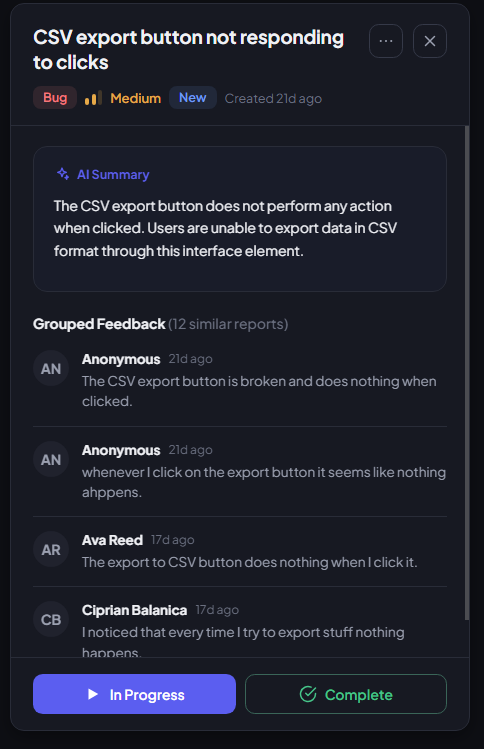
Triagely is the worked example of this job. It pulls bug reports, feature requests and support email into one place per project; its AI reads every incoming report, groups duplicates into a single ticket automatically, and ranks tickets by priority — low, medium or high. Each ticket carries a volume signal showing how many individual reports it groups, so the most-reported issues rise to the top on their own.
Intake comes three ways: forward your support inbox to a dedicated address, paste in an embeddable widget, or submit through an authenticated write API from your own app. Pricing is flat: Starter €19/mo for one project and Pro €39/mo for unlimited projects, no per-seat fees, with a 7-day free trial (card required up front). You can see the current plans on our pricing page or start a trial directly.
Who it's right for: a solo founder or a 1–10-person team getting feedback from several channels, wasting hours de-duping by hand, who wants to sift and decide — price-sensitive and allergic to enterprise sales.
The honest boundary: there's no built-in public roadmap or voting board out of the box — not Triagely's direct path, though a technical team can push submissions into its triage through their API. If you want a ready-made public board your users log into and vote on, Sleekplan or Featurebase fit that better.
Which customer feedback tool is right for you?
Decide by your situation, not by a feature grid:
- You need to ask a defined question or measure sentiment on a schedule → a survey or CX tool: Typeform or SurveyMonkey for self-serve, Qualtrics or Medallia at enterprise scale.
- You want a public board where users submit and vote, with a roadmap and changelog → Canny, Sleekplan or Featurebase, chosen by budget and by the meter each bills on; Nolt if you just need one board.
- You need self-serve and a consultative enterprise contract is a dealbreaker → steer clear of UserVoice's demo-gated model.
- You're drowning in inbound feedback across channels and need to sift and de-dupe to decide what's next → AI deduplication/prioritization, Triagely can do this
FAQ
What is a customer feedback tool?
Software to collect and/or act on customer feedback. The category splits into tools for asking (surveys and CX measurement) and tools for processing (feedback management, voting boards, and AI triage).
What's the best free customer feedback tool?
It depends which job you have, but there are strong free tiers: Sleekplan's Indie plan is free forever for a single admin, Featurebase's free plan gives one seat, Canny is free up to 25 tracked users, and Productboard's free plan allows 500 notes and 25 contributors.
Survey tool or feedback management tool — which do I need?
If you need to ask for feedback you don't have yet, a survey tool. If you need to process feedback that's already arriving, a feedback management or triage tool. Sending more surveys when you already have a backlog only adds to fatigue.
Why do customers stop answering surveys?
Survey fatigue: being asked repeatedly while rarely seeing the company act on it, so answering starts to feel pointless. In Fortune's reporting, customers describe giving feedback and getting "radio silence" back.
Does Triagely have a public roadmap or voting board?
Not built-in out of the box. A technical team can push submissions into its AI triage through the write-only API, but if you want a ready-made public board and changelog, a roadmap suite fits better.