Canny Alternatives Without the Tracked-User Tax
There's no single best Canny alternative — the right one depends on which pricing model survives your growth. Canny meters by tracked user, so a busier board means a bigger bill. Choose by charging model instead: flat per-workspace (Triagely, Sleekplan, Frill), per-seat (Featurebase), or free and self-hosted (Fider).
If you're a small team drowning in duplicate reports across email, a widget, and your own app and you just want to sift them and decide what's next, Triagely is the flat-priced pick — €19/mo, no per-seat fees, so engagement never moves the bill. If you want a public voting board instead, Sleekplan or Frill fit better. The tool names matter less than the meter behind them, because the meter is what your bill follows as you grow. (For a fuller scored roundup of each option — free tiers, learning curve, roadmap versus triage — see our honest buyer's guide to Canny alternatives.) Here's the entry price for one tool in each model.
| Pricing model | Tool | Entry price |
|---|---|---|
| Flat per-workspace | Triagely | €19/mo |
| Flat per-workspace | Sleekplan | Free tier; $13/mo paid |
| Flat per-workspace | Frill | $25/mo, no free tier |
| Per-seat | Featurebase | Free 1 seat; $29/seat/mo paid |
| Free / self-host | Fider | Self-host free; cloud free, $49/mo Pro |
| (For contrast) Canny | Canny | Free ≤25 tracked users; $99/mo at 100 |
Why does Canny's bill keep going up?
Because Canny counts people, not projects. Its help center defines a tracked user as "anyone with a post, vote, or comment attributed to them," and it automatically bumps you to the next tier the moment you cross a tier's limit. You don't choose to upgrade; a busy week upgrades you.
Reviewers report that these tracked users don't reset month to month — once someone posts, votes, or comments they stay counted unless you delete them, so the number, and the bill, only ratchets upward over your product's life.
The cost curve makes the shape concrete. Canny's pricing is free up to 25 tracked users, then $99/mo (or $79/mo billed yearly) at 100 tracked users. Keep growing and it climbs to $1,349/mo (or $1,079/mo yearly) at 5,000 tracked users, with custom enterprise pricing above that. The line goes up with engagement, not with how much you use the product.
That's the core complaint, and it's a fair one. In a DEV Community post, one developer argues the model "penalizes the very thing feedback platforms are supposed to support: engagement," pointing out that "just 25 people interacting with your feedback board... and you're already being asked to pay." Call it the engagement tax: the busier your board, the more you owe.
Two secondary gripes follow from the same meter. The gap between Canny's advertised price and its real cost is a recurring grievance, because a single popular feature request can drag in hundreds of voters who each count as a tracked user. And per secondary review summaries, integrations buyers expect — HubSpot and other CRM connections — sit behind the top Business tier.
The pricing-model taxonomy: which meter survives growth
Once you see the meter, the whole category sorts into four models. Each one scales with something different, and the "something" is what decides whether the tool fights you as you succeed.
- Flat per-workspace. You pay per project or board; engagement is free. The bill is predictable and only grows if you add more products.
- Per-seat. You pay per teammate; end users are usually free. Cost scales with your team size, not your audience.
- Free / self-host. No licence cost at all. You pay instead in setup time and infrastructure you run yourself.
- Credit / per-maker. Usage-metered and roadmapping-oriented — Productboard Spark is $15/maker/mo billed annually with 250 credits per maker, an enterprise-flavoured plan rather than a lightweight board.
A feedback board exists to attract engagement, so a meter tied to engagement — Canny's — is the one model that gets more expensive precisely when the tool is working. Every other model bills you for something you control.
Flat per-workspace tools (Sleekplan, Frill, Triagely)
Flat per-workspace pricing is the direct answer to the tracked-user tax: you pay for the workspace, and it doesn't matter whether ten people or ten thousand show up.
Sleekplan offers a free-forever Indie tier with unlimited feedback and subscribers, then paid Starter at $13/mo and Business at $38/mo (billed yearly). Every paid plan has a 30-day trial with no card that drops back to the free tier if you don't upgrade. It covers boards, roadmaps, changelogs, and surveys, so it's the fit if you want a full board-and-roadmap suite at a flat price.
Frill has no permanent free plan; its pricing runs Startup $25/mo, Business $49/mo, Growth $149/mo, and Enterprise from $349/mo, with a 14-day no-card trial and one month free on annual billing. It's a clean board, roadmap, and changelog for a team that doesn't need a free tier.
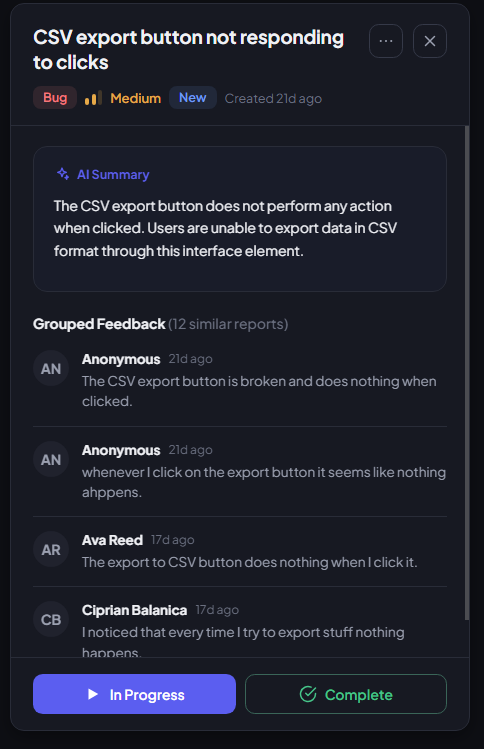
Triagely takes flat pricing in a different direction: instead of a public voting board, it's built to sift feedback and tell you what to work on next. Its AI reads every incoming report, groups duplicates into a single ticket, and ranks what's left by priority. Feedback arrives three ways — forward your support inbox to a per-project email address, paste an embeddable widget onto your site, or submit through an authenticated write API. Pricing is flat: €19/mo for Starter (one project) or €39/mo for Pro (unlimited projects), with no per-seat fees, so engagement never moves the bill. It comes with a 7-day free trial, card required up front.
Who it's right for: a solo founder or small team drowning in duplicate reports across email, a widget, and their app, who wants to sift the pile and decide what's next rather than run a public board. The honest boundary: there's no built-in public roadmap or voting board out of the box — that's not its direct path, though a technical team can push submissions into the triage through the write API, which is write-only today. If you want a ready-made public board, Sleekplan or Frill's suites are the better fit. You can see the full picture on the Triagely homepage or on its pricing page.
Per-seat pricing: Featurebase
Per-seat flips the meter. You pay for internal teammates who need access; your end users aren't metered at all, so engagement stays free and cost scales with your team instead.
Featurebase has a free-forever plan with one seat — unified inbox and ticketing, a help center of up to 50 articles, feedback and roadmaps, and surveys, but no AI. Paid tiers, billed yearly, are Growth $29/seat/mo, Professional $59/seat/mo (with 20 free Lite seats), and Enterprise $99/seat/mo, each plus $0.29 per AI resolution. Startups under two years old with fewer than six employees get 86% off.
Its positioning leans directly on the contrast with Canny: it advertises that it doesn't limit end users, and names Lovable, Raycast, and n8n as customers. That's the whole pitch of the seat model — a growing product team with a large end-user audience but only a few internal seats comes out ahead, because the seat count grows with hiring, not with how popular your board gets.
Free and self-hosted: Fider
If you're technical and want zero licence cost, Fider is open source and free to self-host — you trade money for running your own infrastructure. It's the option that removes the meter entirely, as long as you're willing to own the deploy.
Don't want to run it yourself? Fider's hosted cloud has a Free plan with unlimited customers, feedback, voting, and members (with a fair-use cap of 250 feedback items) and a Pro plan at $49/mo that adds features like SEO indexing. The caveat with self-hosting is the usual one: you own uptime, upgrades, and, on the free cloud tier, that 250-item cap.
Two other models are worth knowing so the map is complete. Nolt bills per board at roughly $25/mo — a secondary-source figure, so treat it as directional rather than a quote. And Productboard Spark, as noted above, is credit-and-per-maker priced and aimed at roadmapping, not a lightweight board.
Which Canny alternative should you pick?
Pick by your situation, not by a feature grid:
- Your board will attract lots of voters and commenters and you want a predictable bill → flat per-workspace (Sleekplan, Frill, or Triagely).
- You have a big end-user audience but a small internal team → per-seat (Featurebase), where the meter follows your headcount, not your traffic.
- You're technical and want zero licence cost → self-host (Fider).
- You want a full public roadmap and changelog suite, ready-made → Sleekplan or Frill.
Triagely fits one reader in particular: the 1–10-person team pulling feedback from email, a widget, and their own app who lose hours de-duping it by hand. Its AI grouping and priority ranking do that sift for you, and the flat €19/€39 pricing means an engaged board never raises the bill. If instead you need a built-in voting board out of the box, one of the roadmap suites above is the better call — you can start a trial if the triage job is the one you actually have.
FAQ
Is there a free Canny alternative?
Yes — several. Fider is free to self-host and has a free cloud tier, Sleekplan has a free-forever Indie plan with unlimited feedback and subscribers, and Featurebase has a free plan with one seat.
What counts as a "tracked user" in Canny?
Anyone with a post, vote, or comment attributed to them. When you exceed a tier's tracked-user limit, Canny automatically bumps you to the next tier.
Do Canny's tracked users reset each month?
Reviewers report that they don't — once someone is counted they stay tracked unless deleted, so the count only ratchets upward. Confirm against Canny's own help-center wording before treating it as a verbatim Canny statement.
How much does Canny cost as it scales?
It's free up to 25 tracked users, then $99/mo (or $79 billed yearly) at 100 tracked users, climbing to $1,349/mo (or $1,079 yearly) at 5,000, with custom pricing above that.
What's the cheapest flat-priced Canny alternative for a solo founder?
Sleekplan (free, or $13/mo paid) and Triagely (€19/mo) both keep the bill fixed no matter how many people engage.
Does Triagely have a public roadmap or voting board?
Not built-in out of the box. A technical team can push submissions into its AI triage through the write API, which is write-only today.