How to Prioritize Customer Feedback When You're Drowning in It
The honest answer to how to prioritize customer feedback is that you can't prioritize a pile you haven't de-duplicated first. Merge the same request across every channel into one item, then score each merged item on two things — how many distinct people asked, and how badly it hurts them — and work down from the top.
The scoring frameworks you've read about come second, and they all quietly assume you've already done the merging. RICE, Kano, and MoSCoW each start from a clean, deduped list — and if you run a small team, that list is never clean. Score a messy pile and you get a confident-looking ranking built on nonsense.
Getting this wrong is expensive. Pendo's 2019 Feature Adoption Report found that 80% of features in the average software product are rarely or never used. Much of that is teams building the loudest thing, not the most-needed one.
Why does prioritizing feedback go wrong before you even score it?
Almost every guide on this topic teaches the scoring math and skips the important part. They open from a tidy, categorized list of distinct requests, the one thing a small team never has. Your feedback shows up as raw noise across email, an on-site widget, support replies, and the occasional DM, and the same issue lands in all of them under slightly different words.
One bug gets reported 40 times, some by email, some through a widget, a couple in DMs. Unmerged, it reads as 40 small, unrelated requests, each easy to wave off. Merge them into a single ticket and it's suddenly the loudest thing you have. Nothing about the problem changed; only whether you could see it.
That's why duplicates silently corrupt every framework. RICE, Value-vs-Effort, weighted scoring — all of them lean on reach, and reach is exactly what splitting breaks. A high-signal issue scattered across a dozen line items scores low on every one of them. The framework isn't wrong. Its inputs are.
So the real shape of the job isn't "apply a scoring model." It's a sift: collect from every channel, merge the duplicates, then score what's left. Skip the front half and you poison the back half.
Even the guides that do mention de-duplication tend to treat it as a tagging chore — one step in a list, somewhere between "categorize" and "segment". It isn't a chore. Merging is the step that decides your ranking, and it deserves to be treated as the main event.
The frameworks everyone recommends — and when they're overkill
To be fair, the standard frameworks exist for a reason. The most common ones you'll see are RICE, Kano, MoSCoW, Value-vs-Effort, and weighted scoring. They're genuinely useful when you have the data and the time to keep them fed.
RICE is the one worth seeing in numbers. You score Reach × Impact × Confidence, divide by Effort, and rank by the result. Usersnap's worked example runs 10,000 reach × 2 impact × 0.9 confidence ÷ 100 effort = 180. Clean and defensible — if you can actually produce those numbers.
That's the catch for a 1–3 person team. Precise reach, a calibrated confidence percentage, an effort estimate in person-hours — these are inputs you can't reliably estimate at your size, and won't maintain week to week. You'll fill them in once and never touch the spreadsheet again.
Backing something lighter isn't lazy. SimplyVoyce's guide for new product teams argues explicitly against heavy frameworks for small teams and reduces prioritization to two questions: how many customers are affected, and how badly. That's the whole idea, and it's enough.
The takeaway: pick the lightest scoring you'll actually keep doing. A rigorous framework you abandon in three weeks ranks nothing. A rough one you run every Friday ranks everything.
A two-factor score you'll actually keep using
Take your list of deduped items and score each one on two axes, 1 to 3: Reach (how many distinct people or accounts asked) and Severity (how badly it blocks or hurts them). Multiply the two for a priority score from 1 to 9. Work the highest numbers first.
Why these two and not RICE's four? Because reach and severity are the only inputs you can read straight off a merged ticket — a volume count you already have, and a quick gut read of the pain. There's no confidence percentage to invent and no effort figure to fake.
Couple of examples:
| Merged item | Reach (1–3) | Severity (1–3) | Priority |
|---|---|---|---|
| Login fails for many accounts | 3 | 3 | 9 |
| Dashboard slow to load | 3 | 2 | 6 |
| Export missing a column | 2 | 2 | 4 |
| Dark mode request | 2 | 1 | 2 |
| Niche CSV tweak (one power user) | 1 | 2 | 2 |
The login failure and the niche CSV tweak make the point. As scattered reports, a broken login can look like a handful of unrelated complaints and lose to the vocal power user asking for an export tweak (reach 1 × severity 2 = 2). Merge the login reports into one item and count them once, and it jumps to a 9 — the top of the list, where it belonged all along.
I ran into this on an older app of mine. Some people complained the text was too small, others that elements were hard to see, and for a few, buttons were missing entirely. Separately, each looked like its own tiny UI bug — three or four fixes, one per complaint. Added together, they pointed at one cause: on some browsers a color wasn't rendering, which broke all of it at once. Deduped, what looked like four scattered fixes was a single bug.
Read reach honestly: it's distinct people, not raw report count. Forty reports from five accounts is a reach of 5, not 40 — otherwise one loud customer emailing daily outranks a quiet problem hitting hundreds. Read severity fast: blocks core work or has no workaround is high; annoying but livable is low. When two items tie, let recent momentum break it.
This is the copyable method most guides never actually hand you. Ten minutes with it and you have a ranked list you can defend.
The four-step loop, start to finish
Turn the method into a checklist you run on a cadence, not a project you plan — the same shape as a weekly triage workflow.
- Collect from every channel into one place. Email, the widget or form on your site, DMs, the support inbox — pull it all to a single destination. Scattered feedback is the root cause of everything above.
- Merge duplicates. Make each real issue exactly one item with a volume count. This is the step the guides skip, and the one that decides your ranking.
- Score with the two-factor method. Reach × severity, and re-score on a fixed cadence — weekly or biweekly — rather than ad hoc when someone shouts loudest.
- Act and close the loop. Ship the top item, then tell the people who asked. Frill relays a Harvard Business Review claim that requesting feedback and following up reduces churn — no metric or year is given, so treat it as a reasonable secondhand claim rather than a hard number, but the instinct is sound.
The whole point is something a founder maintains in minutes a week — not a process that itself needs prioritizing.
What software can you use to deduplicate/prioritize feedback?
Matching a new report against every open ticket, by hand, at volume, is the part that never gets done.
Most of the tools you'll find here are roadmap and voting suites — Canny, Productboard, UserVoice, Frill, Featurebase. They're built around a public board where users post and upvote, and de-duplication is one tagging step inside that. Good fit if a public roadmap is what you want.
One thing to flag fairly on cost: several of them price by tracked users, so your bill climbs the more your users engage. Canny's free plan covers 25 tracked users and scales up from there. One dev, writing about the model, called capping tracked users a "growth tax" — that's his opinion, not a verdict, and the exact paid figures vary by source, so read it as "starts low, scales with tracked users" rather than a fixed number. (We sort the alternatives by exactly this pricing trap in Canny alternatives without the tracked-user tax.)
Triagely is built for exactly the front half this article is about. Its AI reads every incoming report, groups duplicates into one ticket automatically, shows how many reports each ticket groups so the most-reported issues surface, and ranks tickets by priority — the merge-and-rank loop above, done for you. You collect through email forwarding, an embeddable widget, or a write API, and pricing is flat from €19/mo with no per-seat fees and a 7-day free trial (card up front).
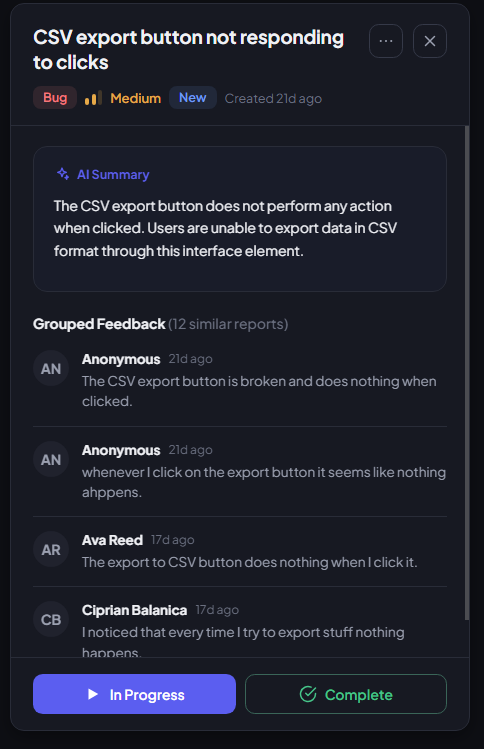
Who it's right for: a small team that wants the merging and ranking handled automatically and doesn't need a public voting board. That last part is the honest limit — a built-in public roadmap isn't Triagely's out-of-the-box path. If what you want is a ready-made public board, a roadmap suite fits better; if you want to stop hand-sorting duplicates every morning, this is the narrower, cheaper tool for that job.
FAQ
What's the difference between organizing and prioritizing customer feedback?
Organizing is the front half — collecting feedback into one place, de-duplicating it, and tagging it. Prioritizing is scoring that cleaned-up list to decide what to build next. You can't do the second honestly without doing the first, because duplicates distort every score.
Do I really need a framework like RICE to prioritize feedback?
No. For most small teams a two-factor reach × severity score is enough, and it's far more likely to survive past week three than RICE's four inputs. If the merging itself is eating your week, that's the point where a tool like Triagely saves the most time.
How do I prioritize when the same request shows up in five different places?
Merge it into a single item first, then count distinct people rather than raw reports — five reports from five channels is often one issue affecting a few accounts. Score that one merged item once, and it stops competing with itself.
Should I prioritize by number of requests or by severity?
Both — that's the entire point of a two-factor score. A rare but blocking issue with no workaround can and should outrank a common but cosmetic one, and multiplying reach by severity is what lets it.
How often should a small team re-prioritize?
On a fixed, light cadence — weekly or biweekly. Re-scoring on a schedule means rising volume changes your ranking before you've spent a sprint building the wrong thing.